


Poker Variance Calculator
Poker variance explains why a winning player can lose for months straight and why a losing player can feel like a genius for weeks. Our poker variance calculator uses a Monte Carlo simulation to show how extreme your results can be with any sample size. This allows you to plan your bankroll, manage your expectations, and distinguish between bad luck and poor play.
Simulation Parameters
Enter your poker statistics to run the variance simulation
Enter your win rate, standard deviation, and sample size below. The simulator runs thousands of randomized scenarios based on your inputs and outputs everything you need: expected winnings, confidence intervals, probability of loss, risk of ruin, maximum drawdown depth, and downswing frequency.

Whether you grind NL Hold’em 6-max or PLO, this tool gives you the statistical reality check every serious player needs.
What Is a Poker Variance Calculator?
A poker variance calculator is a statistical tool that uses your win rate and standard deviation to simulate thousands of possible outcomes and show you the realistic range of results you can expect over a given number of hands.
Using Monte Carlo simulation, the same method employed in quantitative finance and risk analysis, it generates randomized sample paths that model natural poker result fluctuations.
The core insight is simple: Even if you’re a five big blind (bb)/100 winner, your actual results over 50,000 or 100,000 hands may not resemble a smooth upward line at all.
You might run 10, 20, or even 30 buyins below expectation before the math catches up. A variance calculator quantifies exactly how likely these scenarios are, replacing gut feelings with hard probabilities.
This matters because most players either overestimate their edge (attributing a heater to skill) or underestimate their resilience (quitting during a normal downswing).
The calculator strips away the emotional noise and gives you a data-driven framework for bankroll management, stake selection, and long-term planning.
How to Use Our Poker Variance Calculator
Step 1: Enter Your Win Rate (BB/100)
Your win rate is the number of big blinds you win per 100 hands in a meaningful sample size. If you use PokerTracker 4 or Hold’em Manager, this is your “bb/100” stat.
For reference, a solid NL Hold’em 6-max regular wins between 2 and 6 bb/100 after rake. A marginal winner sits between 0.5 and 2 bb/100.
If you don’t know your win rate yet, start with 2.5 bb/100 as a conservative baseline for a competent player at low to mid stakes.
Step 2: Enter Your Standard Deviation (BB/100)
Standard deviation measures how much your results swing around your average. A higher SD means wilder fluctuations. You can find this stat in your tracking software under “Std Dev” or “SD.”
If you don’t have it, use the reference table below to pick the typical value for your game format. For NL Hold’em 6-max, 80-100 bb/100 is a common range.
Step 3: Set Your Sample Size
Enter the number of hands you would like to simulate. Common choices include: 50,000 hands (roughly 1-2 months of part-time grinding), 100,000 hands (a standard evaluation window), 500,000 hands (a solid year of volume for a full-time player), or 1,000,000 hands (career-level perspective).
Larger samples smooth out variance but also reveal just how long downswings can persist.
Step 4: Enter Your Observed Win Rate (Optional)
If you’ve already played a specific sample and want to know how likely your actual results are given your assumed true win rate, enter your observed win rate here.
The calculator will compute the probability of running at or below your observed rate, which helps answer the question: “Am I running bad, or is my win rate lower than I think?”
Understanding Your Poker Variance Calculator Results
So, how do you interpret the results from the poker variance calculator? Here’s the answer:
Expected Winnings and Confidence Intervals
The expected winnings output shows what you’d earn on average given your win rate and sample size. However, averages can obscure the real story.
The 70% confidence interval shows the range where 7 out of 10 players with your exact stats will land. The 95% confidence interval captures where 19 out of 20 will finish.
The gap between these ranges is often shockingly wide. For example, a player who wins 3 big blinds (bb) per 100 hands over 100,000 hands has a 95% confidence range spanning roughly 30 buy-ins in either direction.
Probability of Loss
This is the percentage chance that you’ll be in the red after your specified number of hands, despite being a winning player. For a 2 bb/100 winner with 90 bb/100 standard deviation, the probability of loss after 50,000 hands is around 18-20%.
After 100,000 hands it drops to roughly 10-12%. After 500,000 hands it falls below 2%. These numbers reveal why small winners need enormous bankrolls and tremendous patience.
Maximum Drawdown (Downswing Depth)
Maximum drawdown measures the deepest peak-to-trough decline you’re statistically likely to experience. This is what determines your minimum bankroll.
If the calculator shows a probable max drawdown of 40 buyins over 500,000 hands, your bankroll must exceed that number with a comfortable buffer.
Downswings are measured from your highest point to your lowest subsequent point, and they can start at any time, not just from the beginning of your sample.
Downswing Frequency and Duration
The simulator tracks how often downswings of various depths occur and how long they typically last. A 15-buyin downswing might happen multiple times per 100,000 hands for a typical player.
A 30-buyin downswing is rarer but far from impossible. The duration data is equally important: some downswings last 20,000-50,000 hands, which at typical volume can mean weeks or months of losing. This is normal variance, not a signal that your game is broken.
Standard Deviation by Poker Game Type
One of the most common questions about using a poker variance calculator is, “What standard deviation should I enter?” The answer depends on the game format.
Below are typical SD ranges compiled from large sample databases and industry-standard poker tracking tools.
| Game Format | Typical SD (BB/100) | Notes |
|---|---|---|
| NLH Full Ring (9-max) | 60 – 80 | Tighter play, fewer large pots |
| NLH 6-max | 75 – 120 | Most common online format; LAG styles push SD higher |
| NLH Heads-Up | 100 – 140 | Highest NLHE variance due to constant blind battles |
| PLO Full Ring | 100 – 140 | Closer equities increase swing potential |
| PLO 6-max | 120 – 160 | High multi-way action; aggressive styles can exceed 170 |
| PLO Heads-Up | 140 – 180+ | Extreme variance; bankroll requirements are massive |
Your personal standard deviation (SD) depends on your playing style. Players who frequently make 3- and 4-bets will have higher standard deviations than tight-passive players. There is no inherent superiority, but a higher SD requires a larger bankroll.
How to find your SD in tracking software: In PokerTracker 4, go to “More Filters” > “Statistics” and look for “Std Dev BB/100.”
In Hold’em Manager, it’s under “Reports” > “Session” > “Std Deviation.” If you’ve played at least 20,000 hands, your personal SD is more reliable than the table averages above. Use your actual number for the most accurate simulation.
Risk of Ruin in Poker: What Every Grinder Must Know
Risk of Ruin (RoR) is the probability that you will lose your entire bankroll before it grows to infinity, assuming you stay at the same stake.
It’s the single most important metric for any player who takes bankroll management seriously. A 5% RoR means there’s a 1-in-20 chance you’ll go broke even as a proven winning player. A 1% RoR means 1-in-100.
The standard formula, popularized by Mason Malmuth in Gambling Theory and Other Topics, is:
RoR = e^(-2 x WR x BR / SD^2)
Where WR is your win rate (bb/100), BR is your bankroll in big blinds, and SD is your standard deviation (bb/100). The formula assumes fixed stakes play.
If you move down when losing (which you should), your actual risk is significantly lower.
| Bankroll (Buyins) | RoR at 2 bb/100, 90 SD | RoR at 4 bb/100, 90 SD | RoR at 6 bb/100, 90 SD |
|---|---|---|---|
| 25 buyins (2,500 bb) | 32.6% | 10.6% | 3.5% |
| 50 buyins (5,000 bb) | 10.6% | 1.1% | 0.1% |
| 75 buyins (7,500 bb) | 3.5% | 0.1% | <0.01% |
| 100 buyins (10,000 bb) | 1.1% | <0.01% | <0.01% |
The numbers paint a clear picture. A player who is barely breaking even with a bankroll of 25 buy-ins has a roughly 1-in-3 chance of going broke.
That’s not a bankroll; it’s a coin flip with extra steps. Even with 50 buy-ins, the risk remains above 10%. It’s only at 75 to 100 buy-ins that the risk drops to an acceptable professional level.
Compare that to a solid winner at 4 bb/100: 50 buyins brings risk below 1.5%, which most professionals consider safe.
The takeaway? Your win rate matters exponentially more than your bankroll size. Doubling your win rate from 2 to 4 bb/100 reduces risk far more effectively than doubling your bankroll.
Poker Bankroll Requirements by Format
Based on risk-of-ruin calculations, historical data from our community of grinders, and the variance profiles of each game type, we have determined recommended starting bankrolls.
These calculations assume a target RoR of 5% or less without stake-dropping discipline. With proper stake management, however, you can play for slightly shorter periods.
| Game Format | Player Profile | Recommended Buyins | Risk Level |
|---|---|---|---|
| NLH 6-max | Solid winner (3+ bb/100) | 50 – 75 | Conservative |
| NLH 6-max | Marginal winner (1-2 bb/100) | 100 – 200 | Conservative |
| NLH Full Ring | Solid winner (2+ bb/100) | 40 – 60 | Conservative |
| PLO 6-max | Solid winner (4+ bb/100) | 80 – 120 | Conservative |
| PLO 6-max | Marginal winner (1-3 bb/100) | 150 – 250 | Conservative |
| MTT Grinder | Positive ROI (15%+) | 75 – 125 avg buyins | Moderate |
| Spin & Go / Jackpot SNG | Solid reg | 200 – 500 | High variance format |
These recommendations align with what staking groups and professional bankroll management frameworks use.
If you’re building a bankroll from scratch, our no-deposit poker bonuses and poker freerolls give you a risk-free starting point.
For tournament players, variance is dramatically higher than cash games. A tournament grinder with a 30% ROI can still experience 300+ buyin downswings in terms of average buyin.
Our MTT variance calculator handles the specific math for multi-table tournament variance, which behaves differently from cash games due to payout structures, ICM, and field size effects.
PLO Variance: Why Omaha Swings Harder
If you’ve ever played Pot-Limit Omaha and felt like you were on a rollercoaster, the math confirms your instinct. PLO variance is roughly 40-60% higher than equivalent NLH games, and the reason comes down to equity distribution.
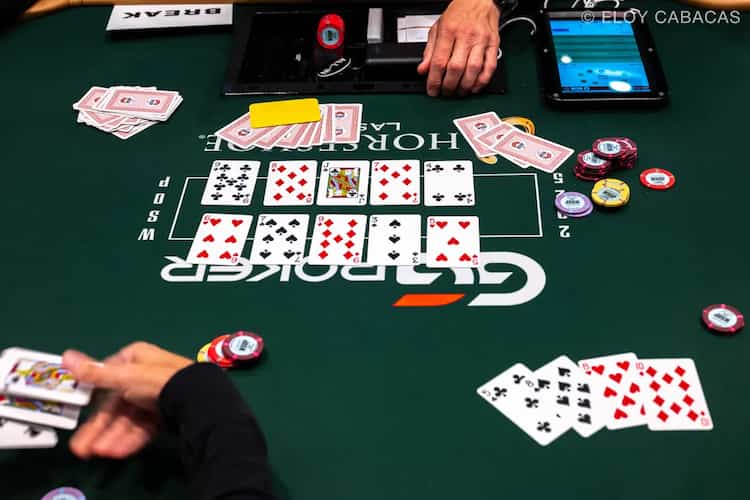
In NLH, you frequently get your money in with a dominant edge. AA vs KK preflop is roughly 80/20. AK vs QJ is about 60/40. These lopsided equity matchups mean that outcomes cluster closer to expectation.
In PLO, those lopsided situations barely exist. Even AAxx vs a random hand is often only a 60-65% favorite. Wrappy hands with connectedness can have 45% equity against pocket aces.
When every all-in is closer to a coin flip, the bell curve of outcomes flattens out, and your standard deviation spikes.
The practical consequence: a PLO player with a 4 bb/100 win rate and 140 bb/100 SD needs roughly 80-120 buyins to maintain less than 5% risk of ruin.
An NLH player with the same win rate and 90 bb/100 SD needs only 50-75 buyins. That’s 50-60% more capital for the same effective edge.
If you grind PLO, use our poker variance calculator with the correct SD range (120-160 for 6-max, 100-140 for full ring) and plan your bankroll accordingly. The biggest mistake PLO players make is applying NLH bankroll rules to an Omaha game.
How Rake Affects Your Variance Exposure
Rake is the silent variance amplifier that most players underestimate. Here’s why: variance and risk of ruin are driven by the ratio of your win rate to your standard deviation.
Rake doesn’t change your SD, but it directly reduces your effective win rate, which destroys that ratio.
Consider this example. You’re a solid NLH 6-max player with a pre-rake win rate of 6 bb/100 and an SD of 90 bb/100. At a site with 4 bb/100 effective rake, your post-rake win rate is 2 bb/100.
At a site with 2.5 bb/100 effective rake (through lower rake or better rakeback deals), your post-rake win rate is 3.5 bb/100.
| Metric | High Rake Site (4 bb/100) | Low Rake / High Rakeback (2.5 bb/100) |
|---|---|---|
| Pre-rake win rate | 6 bb/100 | 6 bb/100 |
| Effective rake | 4 bb/100 | 2.5 bb/100 |
| Post-rake win rate | 2 bb/100 | 3.5 bb/100 |
| RoR at 50 buyins | 10.6% | 2.1% |
| Buyins needed for 1% RoR | ~93 | ~53 |
A 1.5 bb/100 difference in effective rake changes your required bankroll by 40 buyins. That’s not a rounding error. That’s the difference between grinding comfortably and sweating every downswing.
This is exactly why rakeback matters so much for variance management. A 30% rakeback deal on a site charging 5 bb/100 rake returns 1.5 bb/100 to your bottom line.
That returned rake directly boosts your effective win rate, which exponentially reduces your risk of ruin. Check our best rakeback deals to find the sites where your variance exposure is lowest.
Sites like CoinPoker with up to 100% rakeback and GGPoker with Fish Buffet rewards effectively reduce your rake burden, meaning you need a smaller bankroll and face lower risk of ruin at every stake level.
The Kelly Criterion for Poker Bankroll Sizing
The Kelly Criterion is a mathematical formula developed by John Larry Kelly Jr. at Bell Labs in 1956 that calculates the optimal bet size (or stake level) to maximize long-term bankroll growth while minimizing risk of ruin.
It’s widely used in sports betting and investment management, and it applies directly to poker stake selection.
The simplified poker application is:
Optimal fraction of bankroll to risk = Edge / Variance
Or more precisely: f* = (bp – q) / b
Where b is the odds (net profit ratio), p is the probability of winning, and q is the probability of losing (1 – p).
For cash game poker, this translates practically to: if your win rate gives you X big blinds of edge per session, Kelly tells you the maximum stake where your bankroll is optimally sized.
Playing above Kelly means you’re over-leveraged and face unnecessary ruin risk. Playing below Kelly means you’re leaving growth on the table, but with greater safety.
Full Kelly vs. Half-Kelly
Full Kelly maximizes theoretical bankroll growth rate. However, it produces extreme volatility because it assumes you can stomach large drawdowns.
Most professionals use Half-Kelly, which risks half the amount Kelly suggests. Half-Kelly captures approximately 75% of the growth rate at only 25% of the variance. In practice, this means:
If Full Kelly says you need 40 buyins for a given stake, Half-Kelly says use 80 buyins. You grow slightly slower, but the ride is dramatically smoother, and your risk of ruin drops from roughly 13% to under 2%.
For most poker players, Half-Kelly is the practical recommendation. It balances growth with sustainability, especially if your win rate estimate carries uncertainty (which it always does at fewer than 100,000 hands).
Variance and the Mental Game
Understanding variance intellectually is one thing. Surviving it emotionally is another. Here are the key psychological traps that variance creates and how to counter them.
The Gambler’s Fallacy
After 15 buy-ins below expected value (EV), your brain screams that you’re “due” for a hot streak. This is the gambler’s fallacy. Each hand of poker is statistically independent.
The deck doesn’t remember that you lost your last eight all-ins. Your expected value remains the same, whether you just won or lost 20 buy-ins.
The only thing that changes is your psychological state, and that’s where the real danger lies.
The Law of Large Numbers
According to the Law of Large Numbers, as your sample size increases, your observed win rate will converge toward your true win rate. However, “converges” does not mean “corrects.”
If you play 10 buy-ins below expected value (EV) over your first 50,000 hands, those buy-ins are permanently lost.
The law states that the percentage deviation from your expected results will shrink; it does not mean that the universe will refund you.
Tilt as a Variance Amplifier
Most players miss the connection between variance and tilt. Tilt increases effective variance. When you’re on a losing streak and start making emotional decisions, chasing losses, or playing at stakes beyond your comfort level, you’re effectively reducing your win rate (sometimes to zero or below) while maintaining the same standard deviation.
Per the Risk of Ruin formula, a lower win rate with the same SD sends your ruin probability through the roof. This is why the players who handle variance best aren’t the ones who never tilt.
They’re the ones who have stop-loss rules, session limits, and the discipline to drop stakes before tilt destroys their edge. Good poker strategy starts with managing yourself, not just your cards.
From Data to Decision: Using Variance Analysis to Improve
A poker variance calculator is more than just a toy for statistics nerds. It’s a decision-making tool that informs three critical choices in your poker career.
When to Move Up or Down in Stakes
Use the calculator to determine the minimum bankroll required for a RoR of less than 5% at your target stake.
Once your bankroll exceeds that threshold, it is mathematically justified to move up. If it drops below the threshold for your current stake, move down immediately.
This removes emotion from the decision entirely. Our poker bankroll calculator provides stake-specific recommendations to complement this analysis.
When Your Sample Is Large Enough to Trust
A widespread rule of thumb is 100,000 hands for a “reliable” win rate, but that oversimplifies the math. Reliability depends on your SD. At 80 bb/100 SD, 100,000 hands gives you a 95% confidence interval of roughly +/- 1.6 bb/100. At 140 bb/100 SD (PLO), the same sample gives +/- 2.8 bb/100.
For a PLO player with a 3 bb/100 win rate, that confidence interval means your true win rate could be anywhere from 0.2 to 5.8 bb/100, which is nearly useless.
The formula: Margin of Error = 1.96 x SD / sqrt(hands / 100)
At 500,000 hands, the NLH player’s margin drops to +/- 0.7 bb/100, which is finally tight enough to make meaningful stake decisions. For PLO, you need closer to 1,000,000 hands for equivalent confidence.
How to Optimize Your Setup for Lower Variance
Beyond bankroll size, you can reduce your effective variance exposure through several practical steps. Play on sites with the lowest effective rake by combining low base rake with high-value rakeback programs.
Consider table-selecting for softer games where your edge is larger, which improves your win-rate-to-SD ratio. Use equity calculators and pot odds tools to ensure you’re making +EV decisions consistently. Track your results obsessively in PokerTracker 4 or Hold’em Manager to have accurate inputs for your variance simulations.
Frequently Asked Questions About Poker Variance
What is a good standard deviation in poker?
Standard deviation isn’t inherently “good” or “bad.” Rather, it reflects your playing style and game format. For NLH 6-max, 75–100 BB/100 is typical. A standard deviation below 75 suggests a tight-passive style, while a standard deviation above 100 suggests a loose-aggressive approach with frequent 3-betting and large pots. Due to closer equity matchups, PLO standard deviations run 120–160 bb/100. A lower standard deviation (SD) means you need a smaller bankroll for the same win rate. However, it doesn’t inherently mean you’re playing better. Many winning players have high SDs because they aggressively invest when they have an edge.
How many hands do I need to know my true win rate?
The number of hands needed for a rough estimate in NLH depends on your standard deviation. A minimum of 100,000 hands is needed, and even then, your 95% confidence interval spans about +/- 1.6 bb/100. To reach a practically useful confidence level of +/- 0.7 bb/100, you need around 500,000 hands. PLO players need roughly double these numbers due to higher standard deviations. The formula is: Margin of Error = 1.96 x SD / sqrt(hands / 100). You can plug your numbers into our poker variance calculator to see your personal confidence intervals.
How many buyins do I need for NL50?
For NL50 (blinds $0.25/$0.50), a solid winner with a win rate of 3+ bb/100 needs 50–75 buy-ins ($2,500–$3,750). A marginal winner with a 1-2 bb/100 win rate needs 100-200 buy-ins ($5,000-$10,000). These figures assume no stake-dropping discipline. If you commit to moving down to NL25 when your bankroll drops below 50 buyins, you can start with fewer. Run your specific numbers through the bankroll calculator for a personalized recommendation.
What is risk of ruin in poker?
The Risk of Ruin (RoR) is the probability of losing your entire bankroll before it grows infinitely, assuming you play the same stake indefinitely. RoR is calculated using the formula RoR = e^(-2 x WR x BR / SD²), where WR is your win rate, BR is your bankroll in big blinds, and SD is your standard deviation. Professional players aim for an RoR below 5%, with many targeting 1% or less. The key insight is that RoR decreases exponentially as your win rate increases, but only linearly as your bankroll grows. This makes improving your win rate far more impactful than simply adding money.
Is PLO higher variance than Hold'em?
Yes, significantly. Typically, PLO standard deviations range from 120-160 bb/100, whereas NLH 6-max ranges from 75-100 bb/100. The reason is structural. Preflop, PLO hand equities are much closer together (60/40 or 55/45 matchups are common, as opposed to 80/20 in NLH), and multi-way pots occur more frequently. Therefore, PLO players need a bankroll that is roughly 50-100% larger than NLH players with equivalent win rates. A solid PLO 6-max winner needs 80-120 buyins versus 50-75 for NLH. Use our PLO strategy guide alongside the variance calculator to build a proper Omaha bankroll plan.
How does rake affect poker variance?
Although rake doesn’t affect your standard deviation, it directly reduces your effective win rate, which actually matters for risk of ruin. A difference of 1.5 bb/100 in effective rake (through a lower rake structure or better rakeback) can change your required bankroll by more than 40 buy-ins. For instance, a player with a 6 bb/100 pre-rake win rate requires ~93 buy-ins at a high-rake site (4 bb/100 effective rake), but only ~53 buy-ins at a low-rake site (2.5 bb/100 effective rake) to achieve the same 1% risk of ruin. This is why maximizing rakeback deals is one of the most effective bankroll management strategies.
Can a winning player go on a 100,000-hand downswing?
Yes, and it’s more common than most players realize. A player with a 2 BB/100 winner and a 90 BB/100 SD has a 10-12% chance of ending up in the red after 100,000 hands. That’s about 1 in 9. Deeper downswings of 30–40 buy-ins that persist across 50,000–100,000 hands occur in about 5–10% of simulations for marginal winners. This is why professional players, staking groups, and coaches emphasize that playing a large number of hands reduces the impact of variance and that sample sizes below 100,000 hands reveal little about true ability.
What is the Kelly Criterion in poker?
The Kelly Criterion is a formula that calculates the optimal fraction of your bankroll to risk on any bet. In poker terms, it determines the optimal stake level for your bankroll. The simplified version for poker is optimal stake fraction equals Edge divided by Variance. Most professionals use the Half-Kelly strategy, which risks half of the calculated amount. Half-Kelly captures about 75% of the theoretical growth rate while reducing variance by 75%. In practice, this translates to roughly doubling the bankroll requirements suggested by Full Kelly. If the Kelly criterion suggests 40 buy-ins, the Half-Kelly criterion suggests 80 buy-ins for the same stake.