

Texas Hold’em 2026: Rules, How to Play, and Basic Strategy
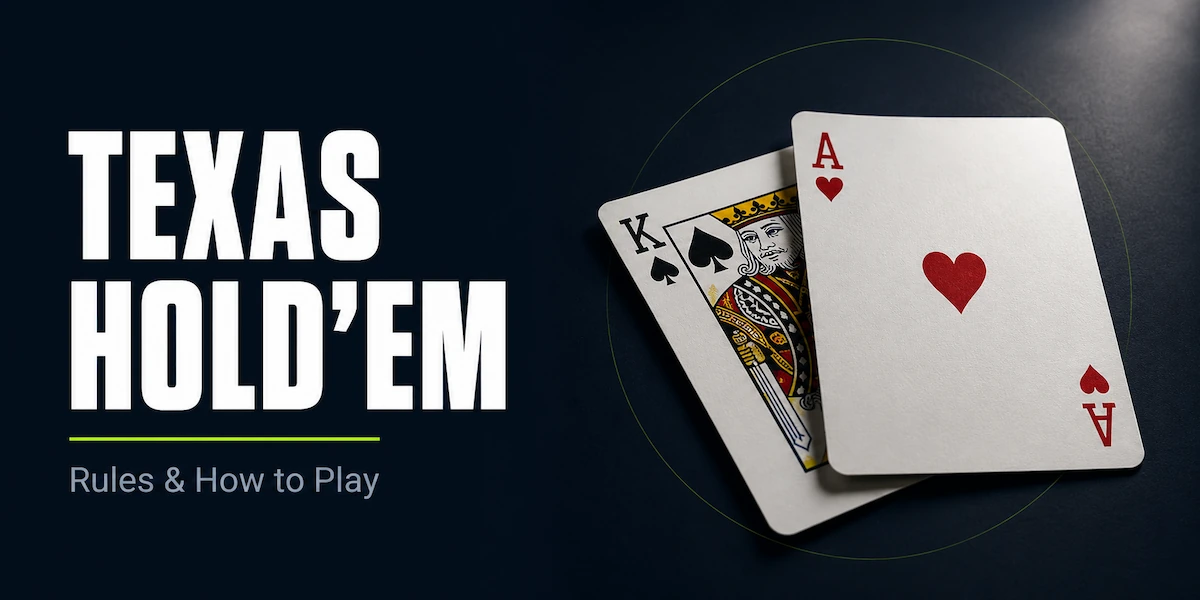
The rules of Texas Hold’em take about 15 minutes to learn, which is part of why it became the most popular form of poker in the world. Each player gets two private cards, five shared cards are dealt face-up in the middle of the table, and whoever makes the best five-card hand wins the pot.
The strategic depth that hooks players for life sits underneath those rules, but you don’t need to know any of it to sit down and play your first hand. Here is what this guide covers:
- The full rules including blinds, all four betting rounds, showdown, and all-in mechanics
- The six table positions and why where you sit changes which hands are worth playing
- A complete example hand played from the first card dealt to the final pot awarded
- Five mistakes that cost beginners the most money and how to fix them
What Is Texas Hold’em
Texas Hold’em is a community card poker game played with a standard 52-card deck. Each player is dealt two private cards (called hole cards) and shares five community cards with the rest of the table. The goal is to make the best five-card hand from any combination of your hole cards and the community cards using standard poker hand rankings, or to convince every other player to fold before the cards are shown.
The game is played for chips that represent real money in cash games or for tournament chips that pay out cash prizes at the end of an event. Anywhere from 2 to 10 players can sit at a single table, with 6-max (six-player) tables being the standard format online and full ring (nine or ten players) more common in live casinos and home games.
How a Hand of Texas Hold’em Plays Out
Every hand follows the same sequence. A small disc called the dealer button sits in front of one player and rotates one seat to the left after every hand. Two players are forced to put money into the pot before any cards are dealt: the player directly to the left of the button posts the small blind, and the player two seats to the left posts the big blind, which is twice the size of the small blind.
These forced bets exist to create action. Without them, players could fold every weak hand for free and wait for premium cards indefinitely. Once the blinds are posted, each player receives two cards face-down, and the hand moves through four betting rounds with community cards revealed between them.
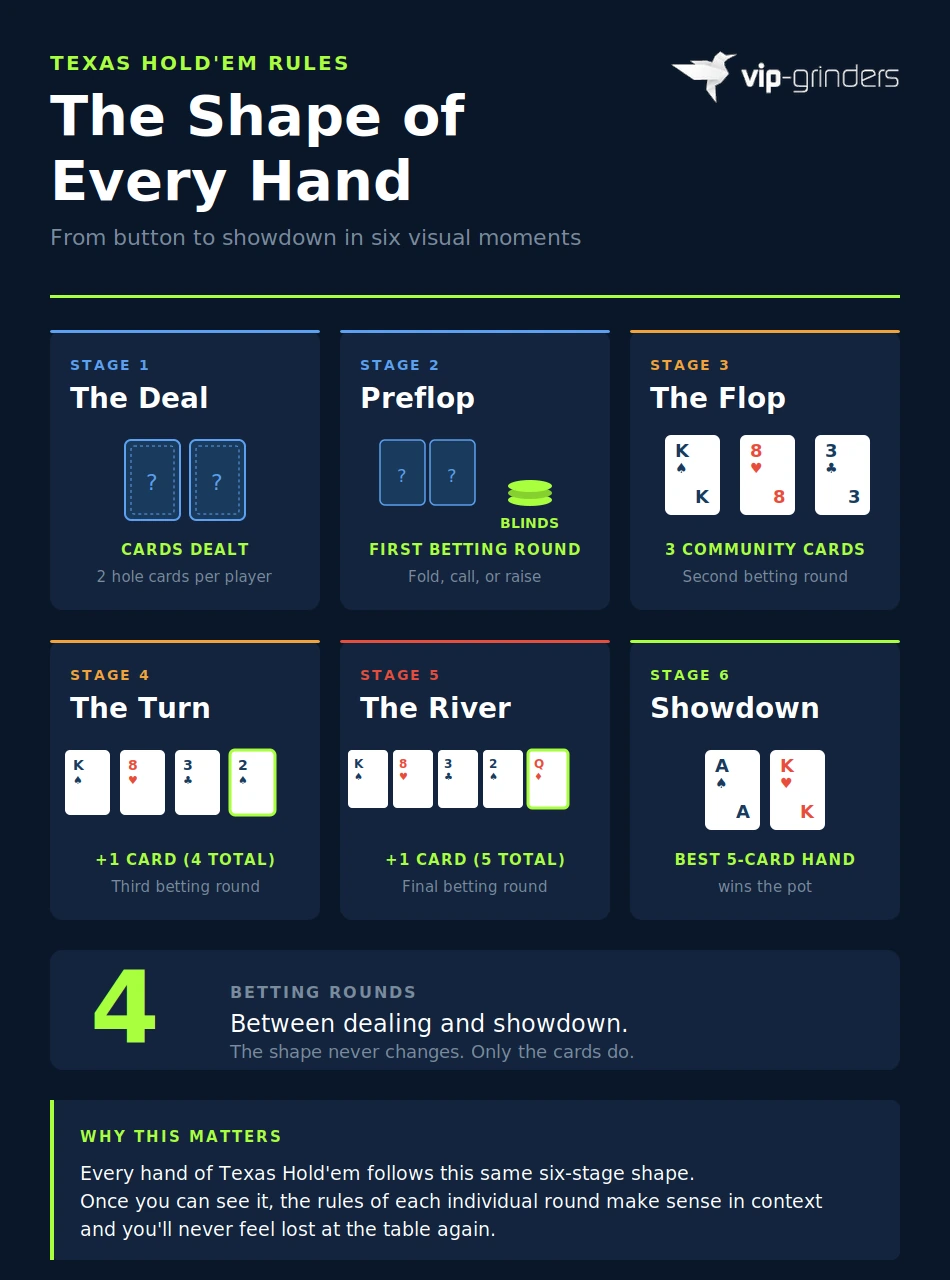
The Ten Steps of Every Hand
- 1Blinds are posted. The small blind and big blind put their forced bets into the pot before any cards are dealt.
- 2Hole cards are dealt. Each player receives two cards face-down, visible only to them.
- 3First betting round (preflop). Starting with the player to the left of the big blind, each player can fold, call the big blind, or raise.
- 4The flop is dealt. Three community cards are placed face-up in the middle of the table.
- 5Second betting round. Starting with the first active player to the left of the button, each remaining player can check, bet, call, raise, or fold.
- 6The turn is dealt. A fourth community card is placed face-up next to the flop.
- 7Third betting round. Same action options as the second round, starting again with the first active player left of the button.
- 8The river is dealt. A fifth and final community card is placed face-up next to the turn.
- 9Final betting round. The last chance for remaining players to bet before the cards are shown.
- 10Showdown. Any players still in the hand reveal their cards, and whoever has the best five-card hand wins the pot.
A hand can end at any of these ten steps if all but one player folds. The last remaining player wins the pot without having to show their cards, which is one of the reasons bluffing is part of the game. If two or more players are still in the hand after the final betting round, showdown decides the winner.
The Five Betting Actions
Every decision you make at the table is one of these five actions:
- Fold: throw your cards away and give up any chips you’ve already put in the pot. You’re out of the hand.
- Check: pass the action to the next player without putting any more chips in. Only available if no one has bet before you on the current round.
- Bet: put chips into the pot when no one else has bet yet on the current round.
- Call: match the amount someone else has bet to stay in the hand.
- Raise: increase the bet after someone else has already bet on the current round.
A betting round ends when every remaining player has either matched the highest bet or folded. Once the round closes, the next community card (or cards) is dealt and a new betting round begins.
Preflop: The First Betting Round
Preflop happens right after each player receives their two hole cards. The action starts with the player directly to the left of the big blind (a seat called under the gun) and moves clockwise. Each player can fold, call the big blind, or raise.
The big blind has a special privilege: if no one has raised by the time the action reaches them, they can check and see the flop for free. If someone has raised, the big blind can call, re-raise, or fold like any other player.
Flop, Turn, and River
After preflop betting ends, the remaining three rounds follow the same pattern: new community cards are revealed, then a betting round starts with the first active player to the left of the button.
- The Flop: three community cards are dealt face-up. Players can now check (pass without betting) or bet. Once someone bets, others can fold, call, or raise.
- The Turn: a fourth community card is added. Same betting rules as the flop. Pots usually grow here as players commit more chips with strong hands and draws.
- The River: a fifth and final community card is dealt. This is the last betting round before showdown. Every player now has seven cards (two hole cards plus five community cards) to make their best five-card hand.
Showdown and the Five-Card Rule
Showdown happens when two or more players are still in the hand after the river. The player who made the last bet or raise shows first. If everyone checked the river, the first active player left of the button shows first.
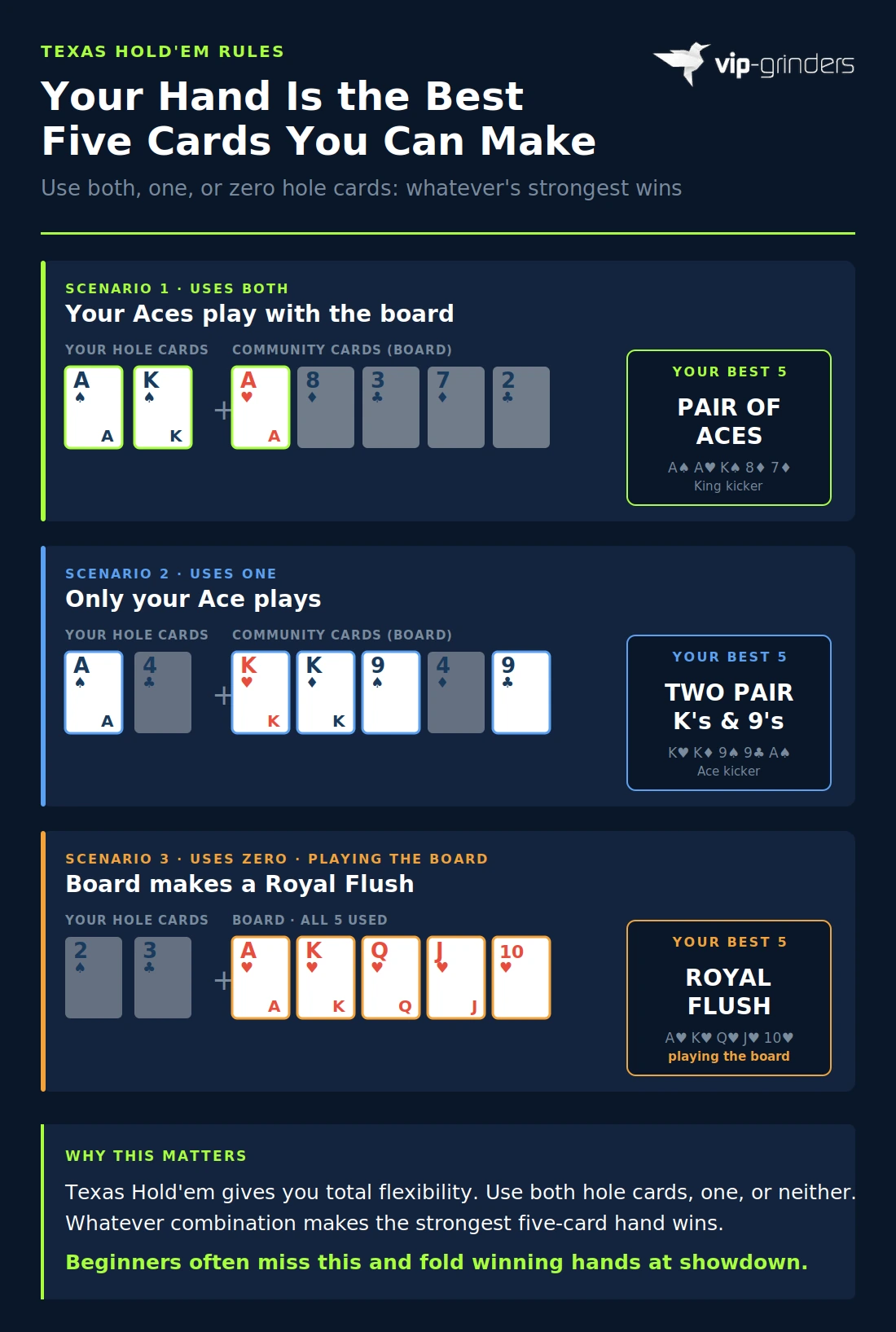
Every hand at showdown is exactly five cards. You make your best five-card combination from the seven cards available (your two hole cards plus five community cards). You can use both hole cards, one, or even zero if the board alone makes the strongest hand, which is called playing the board.
When two or more players have hands of identical strength, the pot is split equally. This is called a chopped pot, and it happens more often than beginners expect.
The table below shows all ten hand rankings from strongest to weakest. This is the hierarchy that decides every showdown.
| Rank | Hand | What It Is |
|---|---|---|
| 1 | Royal Flush | A, K, Q, J, 10 all of the same suit |
| 2 | Straight Flush | Five consecutive cards of the same suit |
| 3 | Four of a Kind | Four cards of the same rank |
| 4 | Full House | Three of a kind plus a pair |
| 5 | Flush | Five cards of the same suit, any order |
| 6 | Straight | Five consecutive cards, mixed suits |
| 7 | Three of a Kind | Three cards of the same rank |
| 8 | Two Pair | Two different pairs |
| 9 | One Pair | Two cards of the same rank |
| 10 | High Card | No combination; highest card plays |
All-In Bets and Side Pots
An all-in bet happens when a player pushes all their remaining chips into the pot. Once all-in, you can’t be bet out of the hand: you’re guaranteed to see every remaining community card and reach showdown.
If opponents have more chips than you, they keep betting in a separate side pot that you have no claim to. The core rule: you can only win the chips you’ve matched. Online software handles side pot math automatically.
The Six Positions at the Table
Your position at the table is one of the most important factors in Texas Hold’em. Position determines when you act in each betting round, how much information you have when making decisions, and which hands are worth playing. The same two cards can be a clear fold from one seat and a clear raise from another.
A standard 6-max table has six positions, each with its own name and role. Knowing the positions and how they relate to each other is the first step to understanding why some seats are profitable and others are difficult.
The Six Positions in Order
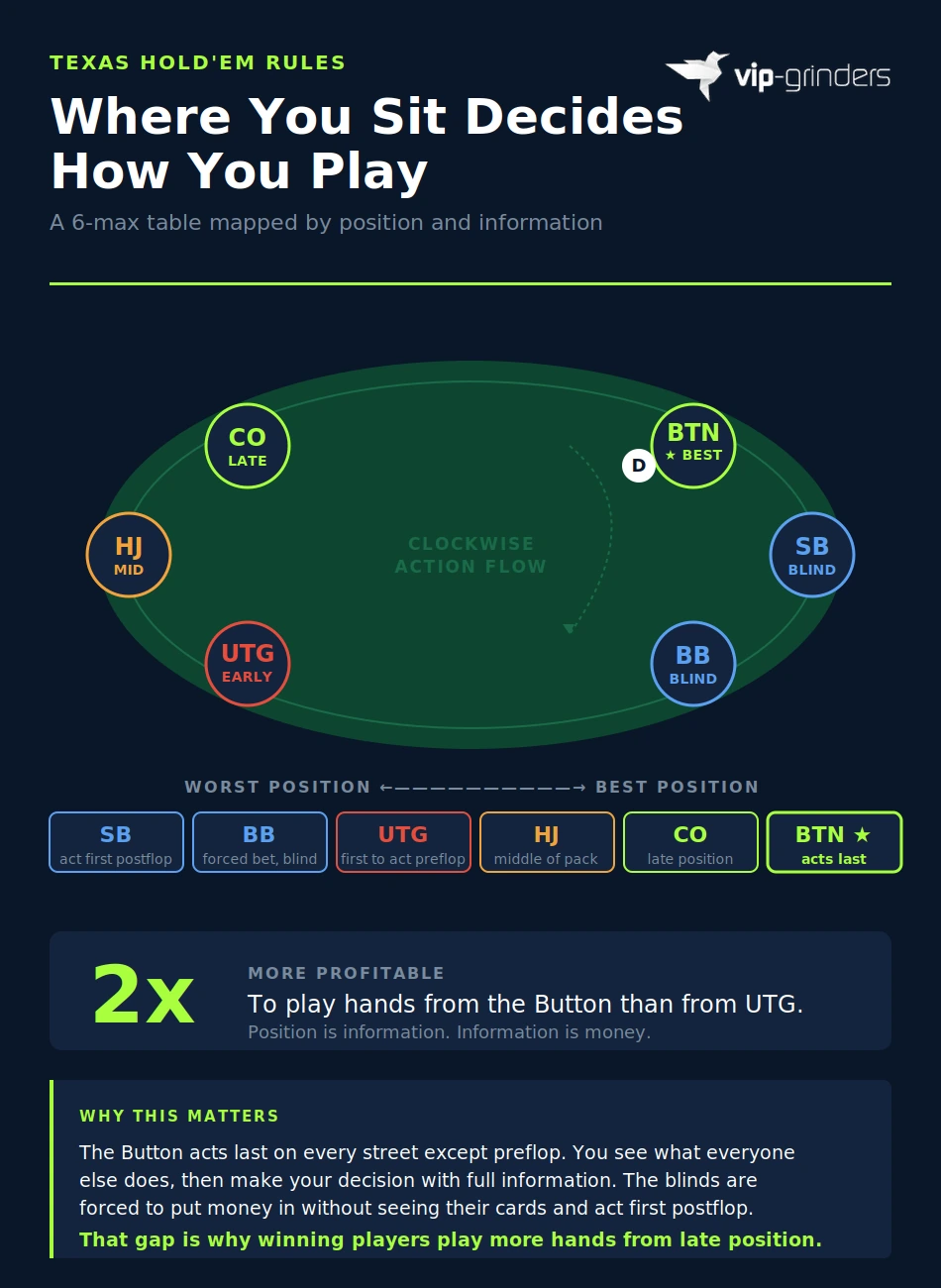
Starting from the player directly to the left of the dealer button and moving clockwise around the table, the six positions are:
- Small Blind (SB): directly to the left of the button. Posts the small blind before cards are dealt.
- Big Blind (BB): two seats to the left of the button. Posts the big blind before cards are dealt.
- Under the Gun (UTG): three seats to the left of the button. Acts first preflop.
- Hijack (HJ): two seats to the right of the button.
- Cutoff (CO): one seat to the right of the button.
- Button (BTN): the player with the dealer button. Acts last on every betting round after the flop.
In a 9-handed full ring game, three more seats are added between the big blind and the hijack: UTG+1, UTG+2, and middle position (MP). The basic principle is the same: the closer you are to the button, the later you act, and the more information you have when it’s your turn.
Why Late Position Is a Huge Advantage
The reason position matters so much is simple: information. Every player who acts before you reveals something about their hand by what they do (call, raise, fold, check). By the time the action reaches you in late position, you’ve watched everyone else make a decision and you know who’s interested in the pot and who isn’t.
The Button is the best seat at the table because you act last on every street except preflop. You see what everyone else does, then make your decision with full information. The blinds are the worst positions because you’ve been forced to put money in without seeing your cards, and you have to act first on every betting round after the flop.
This is why winning players play more hands from late position and fewer hands from early position. From the button, a winning player might open one in every three hands; from under the gun, one in every six.
Strong starting hands include big pairs (A♠ A♣, K♥ K♦), Ace-King, and suited connectors like J♥ :th:. Weak hands like 7♦ 2♣ or 9♠ 3♥ should be folded from every position. The exact hands to play from each seat and how to build a preflop strategy from scratch is covered in our poker ranges guide.
A Complete Example Hand from Start to Finish
The fastest way to put everything together is to walk through a real hand from the first card dealt to the final pot being awarded. The example below is a 6-max No-Limit Hold’em cash game at $1/$2 stakes, meaning the small blind is $1 and the big blind is $2. Each player started the hand with a $200 stack (100 big blinds, the standard buy-in for cash games).
Follow along street by street and you’ll see every rule from the previous sections in action.
Setup and Preflop Action
Six players are seated. The dealer button is in front of Seat 6. The small blind ($1) is posted by Seat 1, and the big blind ($2) is posted by Seat 2. Cards are dealt face-down, two to each player.
Here are the hole cards for the three players who matter to this hand:
- Seat 4 (Cutoff): A♠ K♥
- Seat 6 (Button): 8♠ 8♦
- Seat 2 (Big Blind): 7♥ 6♥
The action starts with Seat 3 (Under the Gun), who folds. Seat 4 (Cutoff) raises to $6. Seat 5 folds. Seat 6 (Button) calls $6. Seat 1 (Small Blind) folds. Seat 2 (Big Blind) calls the additional $4 to match the raise.
Three players see the flop. The pot is now $19 ($6 from each of the three callers, plus the $1 small blind that folded).
The Flop
The dealer burns one card and reveals the flop:
Flop: K♦ 8♥ 3♣
This is a strong board for two of our three players. Seat 4 has top pair with the best possible kicker (Ace-King), and Seat 6 has flopped a set of eights (three of a kind). Seat 2 has missed completely with no pair and no draw.
The action starts with Seat 2 (Big Blind), who acts first because they’re left of the button. Seat 2 checks. Seat 4 bets $12 into the $19 pot. Seat 6 calls $12. Seat 2 folds.
Two players see the turn. The pot is now $43 ($19 from the flop plus $12 from each of the two players who continued).
The Turn
The dealer burns one card and reveals the turn:
Turn: K♦ 8♥ 3♣ 2♠
Seat 4 still has top pair with top kicker. Seat 6 still has a set of eights. The 2 of spades didn’t help either player.
Action starts with Seat 4, who bets $25. Seat 6 raises to $70. Seat 4 calls $45 more.
Two players see the river. The pot is now $183 ($43 from the turn plus $70 from each player).
The River and Showdown
The dealer burns one card and reveals the river:
River: K♦ 8♥ 3♣ 2♠ Q♦
The Queen of diamonds doesn’t change either player’s hand. Seat 4 still has one pair of Kings with an Ace kicker. Seat 6 still has three of a kind, eights.
Action starts with Seat 4, who checks. Seat 6 bets $100. Seat 4 calls.
At showdown, Seat 6 (the last aggressor) shows first: 8♠ 8♦ for three of a kind, eights. Seat 4 reveals A♠ K♥ for one pair of Kings with an Ace kicker.
Seat 6 wins the $383 pot with three of a kind. Seat 4 invested $188 across all four streets ($6 preflop, $12 flop, $25 turn bet, $45 turn raise call, and $100 river call) and lost the entire amount.
Five Mistakes That Cost Beginners the Most
Most beginners lose money in Texas Hold’em not because they make complicated strategic errors, but because they repeat the same handful of basic mistakes hand after hand. Fix these five and your results will improve immediately, regardless of which stake or format you play.
- 1Playing too many hands preflop. Beginners see two cards and look for reasons to play rather than reasons to fold. Most hands you’re dealt are unprofitable and should be mucked before the flop, especially from early position.
- 2Calling when you should fold or raise. Calling is the weakest action in poker. If your hand is strong enough to continue, it’s usually strong enough to raise. If it’s not strong enough to raise, it’s usually not strong enough to call.
- 3Ignoring position. Beginners play the same hands from every seat. Winning players fold marginal hands from early position and open wider from late position because position gives them more information on every street.
- 4Chasing draws without checking the price. Calling a big bet to chase a flush or straight is only profitable when the pot is offering you the right odds. Our pot odds guide covers how to calculate this in seconds.
- 5Going on tilt after a bad beat. Losing a big pot to a worse hand is part of poker. Letting it change how you play the next 10 hands costs more than the bad beat itself.
These five mistakes are responsible for the majority of money beginners lose at the tables. Each one is fixable through awareness and discipline rather than studying complex strategy. Patch these leaks first, then move on to the more advanced material in our spoke guides.
Where to Go from Here
You now know the rules of Texas Hold’em, how a hand plays out, what positions mean, and the most common mistakes to avoid. A natural learning sequence for most beginners looks like this:
- 1Memorize the hand rankings so you never misread your hand at showdown.
- 2Learn pot odds so you know when to call with a draw and when to fold.
- 3Build a preflop range so you know which hands to play from each position.
- 4Choose a format and focus your practice there rather than jumping between cash games, tournaments, and Spin & Gos.
The first three steps are covered in the spoke guides linked throughout this article. For step four, cash games let you sit down and leave whenever you want with chips worth real money, while tournaments have a fixed buy-in and pay out top finishers from a shared prize pool. Both formats use the same Texas Hold’em rules you just learned.
Once you’ve absorbed the basics, the fastest way to improve is to play real-money stakes, even at the smallest blinds. Our list of real money poker sites covers the rooms with the softest games and the most reliable payout reputations for new players.
Frequently Asked Questions
What are the basic rules of Texas Hold'em?
Each player is dealt two private cards (hole cards), and five community cards are revealed face-up in the middle of the table across three stages (the flop, turn, and river). Players bet across four rounds, and the player with the best five-card hand at showdown wins the pot. You can use both, one, or neither of your hole cards to make your final hand.
How many cards do you get in Texas Hold'em?
Each player receives two hole cards face-down at the start of the hand. Five community cards are then dealt face-up across the flop (3 cards), turn (1 card), and river (1 card), giving every active player seven total cards to work with. The best five-card combination from those seven cards wins the pot.
What is the difference between poker and Texas Hold'em?
Poker is the broader category of card games that includes Texas Hold’em, Pot-Limit Omaha, Seven-Card Stud, Razz, Short Deck, and several others. Texas Hold’em is the most popular specific variant of poker, played at the World Series of Poker Main Event and on virtually every televised event. When most people say “poker,” they mean Texas Hold’em.
What are the blinds in Texas Hold'em?
The blinds are two forced bets that two players are required to put into the pot before any cards are dealt. The small blind is posted by the player directly to the left of the dealer button, and the big blind is posted by the next player to the left and is twice the size of the small blind. Blinds exist to force action into every hand and prevent players from waiting forever for premium hands.
What is the flop, turn, and river?
The flop is the first three community cards revealed after the preflop betting round. The turn is the fourth community card, dealt after flop betting ends. The river is the fifth and final community card, dealt after turn betting ends. Each new street is followed by another betting round.
How does all-in work in Texas Hold'em?
An all-in bet is when a player pushes all their remaining chips into the pot. Once all-in, that player can’t be bet out of the hand and is guaranteed to see every remaining community card and reach showdown. If opponents have more chips than the all-in player, those extra chips go into a side pot that only the deeper players can win.
What is the best starting hand in Texas Hold'em?
The best starting hand is a pair of Aces (often called “pocket rockets” or “American Airlines”). Pocket Aces win against any other two-card combination preflop more often than any other hand. The next strongest hands are pocket Kings, pocket Queens, pocket Jacks, and Ace-King suited.
Is Texas Hold'em a game of skill or luck?
Texas Hold’em is a game of skill played with random elements. In any single hand, luck plays a major role because the cards are random. Over thousands of hands, skill becomes dominant: the best players consistently win money from weaker opponents because their decisions are better on average. Most jurisdictions that have studied the question legally recognize poker as a game of skill.