

Poker Hand Rankings: Complete Chart & Guide 2026
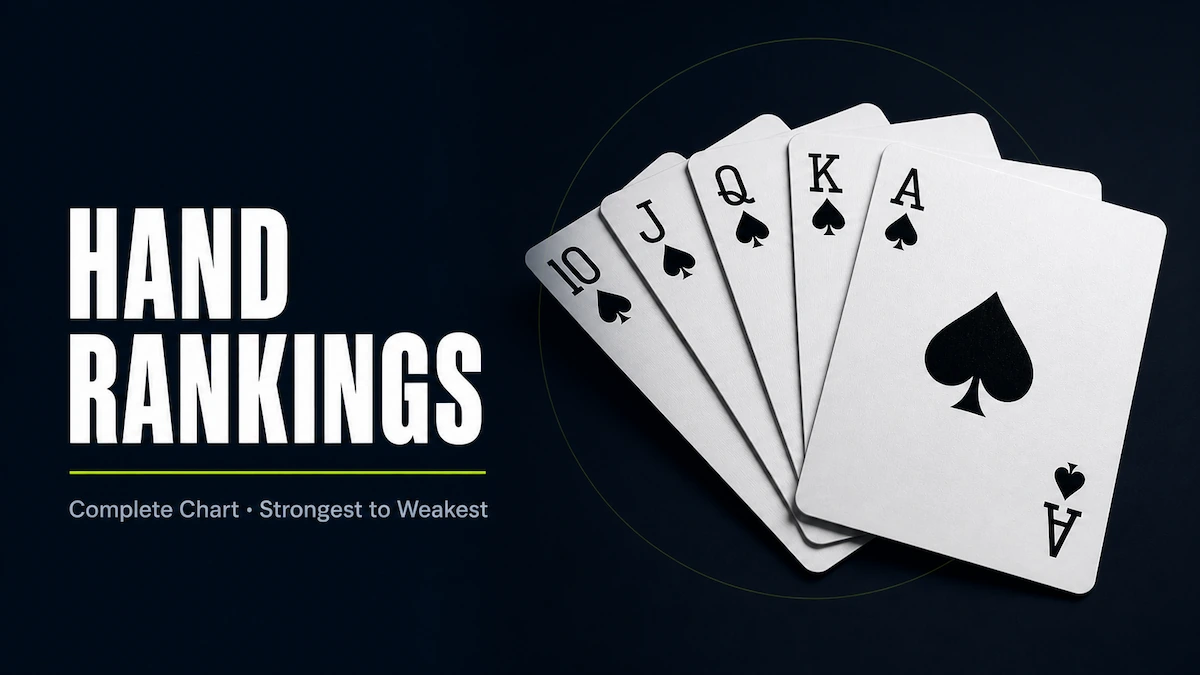
There are 10 standard poker hands, ranked from Royal Flush (strongest) down to High Card (weakest). The same hierarchy applies to Texas Hold’em, PLO, Stud, and virtually every other variant. This guide gives you the complete chart with exact probabilities, kicker tiebreaker rules, and the ranking changes for Short Deck and Omaha.
If you are completely new to the game, start here and then move to our Texas Hold’em rules guide for how a hand plays out from blinds to showdown.
Here is what this guide covers:
- Complete chart of all 10 hands with exact probabilities and card examples
- Kicker and tiebreaker rules so you never misread a showdown
- Short Deck and PLO differences where the standard rankings change
- Key insight per hand covering the mistake beginners make most often
Poker Hands Ranked: Quick Reference Chart
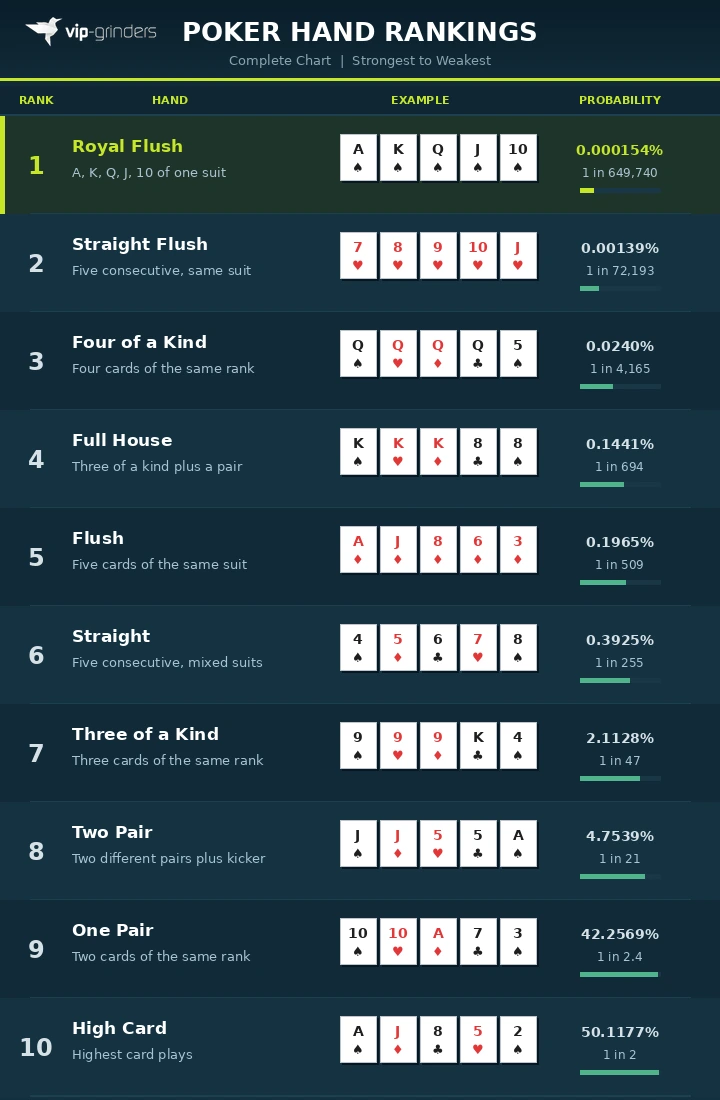
The table below lists every standard poker hand from strongest to weakest. These rankings apply to Texas Hold’em, Pot-Limit Omaha, Stud, and most other popular variants. Short Deck (6+ Hold’em) uses a modified hierarchy covered further down the page.
| Rank | Hand | Example | Probability (5 cards) | Description |
|---|---|---|---|---|
| 1 | Royal Flush | A♠ K♠ Q♠ J♠ 10♠ | 0.000154% | A, K, Q, J, 10 of the same suit |
| 2 | Straight Flush | 7♥ 8♥ 9♥ 10♥ J♥ | 0.00139% | Five consecutive cards of the same suit |
| 3 | Four of a Kind | Q♠ Q♥ Q♦ Q♣ 5♠ | 0.0240% | Four cards of the same rank |
| 4 | Full House | K♠ K♥ K♦ 8♣ 8♠ | 0.1441% | Three of a kind plus a pair |
| 5 | Flush | A♦ J♦ 8♦ 6♦ 3♦ | 0.1965% | Five cards of the same suit, any order |
| 6 | Straight | 4♠ 5♦ 6♣ 7♥ 8♠ | 0.3925% | Five consecutive cards, mixed suits |
| 7 | Three of a Kind | 9♠ 9♥ 9♦ K♣ 4♠ | 2.1128% | Three cards of the same rank |
| 8 | Two Pair | J♠ J♦ 5♥ 5♣ A♠ | 4.7539% | Two different pairs plus a kicker |
| 9 | One Pair | 10♠ 10♥ A♦ 7♣ 3♠ | 42.2569% | Two cards of the same rank |
| 10 | High Card | A♠ J♦ 8♣ 5♥ 2♠ | 50.1177% | No pair or better; highest card plays |
The probabilities above are based on a standard 52 card deck and represent the odds of being dealt each hand in exactly five cards. In Texas Hold’em you build the best five card hand from seven available cards (two hole cards plus five community cards), which makes strong hands more common than the raw numbers suggest.
For example, the probability of flopping a Flush draw and completing it by the river is far higher than the 0.19% figure in the chart. Those game specific odds connect directly to pot odds and implied odds, which are covered in separate guides.
Every Poker Hand Explained
The chart above gives you the ranking order. This section adds the one thing a chart cannot: the key insight and the most common mistake for each hand.
1. Royal Flush
The best possible hand: A♠ K♠ Q♠ J♠ 10♠ (or any suit). It is the highest Straight Flush and cannot be beaten. If two players both make a Royal Flush in different suits, the pot is split because suits have no ranking in poker.
Most players go their entire career without seeing one. In Texas Hold’em with seven cards available, the odds improve to roughly 1 in 30,940, but it remains the rarest hand at a real table.
2. Straight Flush
Five consecutive cards of the same suit, excluding A-K-Q-J-10. Example: 7♥ 8♥ 9♥ 10♥ J♥. The highest card determines the winner when two players both have one.
The lowest possible Straight Flush is A-2-3-4-5 suited (called a “steel wheel”), where the Ace plays low. Suits have no ranking: a Straight Flush in hearts and one in spades of the same rank split the pot.
3. Four of a Kind (Quads)
Four cards of the same rank plus one unrelated card. Example: Q♠ Q♥ Q♦ Q♣ 5♠. The higher set of four wins. If the Quads are on the board, the kicker decides.
Common trap: players holding a pocket pair on a board that pairs their card often slow play Quads. Checking back too many streets is one of the most frequent missed value spots at low stakes.
4. Full House (Boat)
Three of a kind plus a pair. Example: K♠ K♥ K♦ 8♣ 8♠ (“Kings full of Eights”). The three of a kind portion determines the winner first. If tied, the pair breaks it.
Full Houses are where beginners lose the most money in big pots. Holding 8♠ 8♥ on a board of K♦ K♣ 8♦ 4♠ 2♥ gives you Eights full of Kings, but anyone with a single King has Kings full and beats you. Always check whether your trips or your pair is the higher component.
5. Flush
Five cards of the same suit in any order. Example: A♦ J♦ 8♦ 6♦ 3♦. The highest card determines the winner, then the second highest, and so on.
When three or four suited cards appear on the board, multiple players can make a Flush. The one with the highest suited hole card wins. Holding the Ace of the Flush suit (the “nut Flush draw”) is strong; holding a low Flush on a four-suited board is often a trap that costs beginners big pots.
6. Straight
Five consecutive cards of mixed suits. Example: 4♠ 5♦ 6♣ 7♥ 8♠. Ace can play high (A-K-Q-J-10) or low (A-2-3-4-5, called “the wheel”), but cannot wrap around (Q-K-A-2-3 is not a Straight).
The most expensive Straight mistake is playing the “idiot end” (bottom of the sequence). Board shows 7♥ 8♦ 9♠ and you hold 5♣ 6♣. Any player with a 10♣ has a higher Straight. Getting stacked with the bottom end is one of the costliest recurring leaks at low stakes.
7. Three of a Kind (Trips or a Set)
Three cards of the same rank plus two unrelated cards. Example: 9♠ 9♥ 9♦ K♣ 4♠. There is an important distinction in Hold’em.
A Set means you hold a pocket pair and one matching card is on the board. Trips means the board has a pair and you hold one matching card. Sets are much stronger because they are harder for opponents to read, less likely to be counterfeited, and have Full House redraw potential. This distinction matters more as you move into range thinking and value betting.
8. Two Pair
Two different pairs plus one kicker. Example: J♠ J♦ 5♥ 5♣ A♠. The highest pair is compared first, then the second pair, then the kicker.
Two Pair causes the most showdown confusion among beginners. Holding A♠ J♦ on a board of J♥ 5♦ 5♣ 8♠ 2♥ gives you Jacks and Fives with an Ace kicker. If your opponent holds K♦ J♣, they also have Jacks and Fives, but your Ace kicker wins. Note: you can never “use” three pairs in poker. The best two pairs plus the best kicker form your five card hand.
9. One Pair
Two cards of the same rank plus three unrelated cards. Example: 10♠ 10♥ A♦ 7♣ 3♠. The rank of the pair matters first, then kickers are compared highest to lowest.
One Pair is the hand you will play most often: 42% of all five card combinations contain exactly one pair. Kickers matter constantly. Holding A♠ K♦ on a board of K♥ 9♣ 5♦ 3♠ 2♥ beats K♣ Q♥ because your Ace outranks their Queen. This is why starting hand selection stresses strong kickers from the very beginning.
10. High Card
No pair or better. The highest card plays. Example: A♠ J♦ 8♣ 5♥ 2♠ (“Ace high”). If the top card ties, the second card is compared, then the third, and so on.
Over half of all five card combinations are High Card, which is exactly why bluffing exists: most hands miss, and the player who bets with confidence often wins regardless of their actual cards. Understanding this is the first step toward concepts like fold equity.
Kickers, Ties & Tiebreakers
One of the most misunderstood areas in poker is how ties are broken when two players hold the same type of hand. The rules are simple once you know them, but getting them wrong at showdown costs real money.
A kicker is the highest unpaired card in your hand that is used to break ties. Kickers only matter when two players have the same pair, two pair, three of a kind, or when the board plays. They never matter for Straights, Flushes, Full Houses, or Quads (unless the Quads are entirely on the board).
When Kickers Decide the Winner
- One Pair: if both players have the same pair, the highest kicker wins. Up to three kickers can be compared.
- Two Pair: if both pairs match, the single remaining kicker decides.
- Three of a Kind: if the trips are identical (only possible with board trips), the two kickers are compared.
- High Card: all five cards are compared from highest to lowest until a difference is found.
When Kickers Do NOT Matter
- Straights: all five cards form the hand. No kicker exists. Two identical Straights split the pot.
- Flushes: all five suited cards are compared top down. There is no separate kicker; the five Flush cards ARE the hand.
- Full Houses: the trips are compared first, then the pair. No kicker is used.
Kicker Example: Why AK Beats AQ
This is the most common kicker situation at any real money table.
| Player | Hole Cards | Board | Best 5 Card Hand | Result |
|---|---|---|---|---|
| Player A | A♠ K♦ | A♥ 9♣ 5♦ 3♠ 2♥ | Pair of Aces, K kicker | Wins |
| Player B | A♣ Q♥ | A♥ 9♣ 5♦ 3♠ 2♥ | Pair of Aces, Q kicker | Loses |
Both players have a pair of Aces. Player A’s King kicker outranks Player B’s Queen. This is not a split pot, even though many beginners assume “we both have Aces, so we chop.”
Your unpaired hole cards always matter when you pair the board. A♠ K♦ versus A♠ 9♦ on an Ace high board is never a split. This is exactly why starting hand guides stress playing strong kickers, especially from early position.
When the Board Plays (Chopped Pots)
If the five community cards form a hand that is better than anything either player can make using their hole cards, the pot is split. For example:
Board: A♠ K♥ Q♦ J♣ 10♠
Player A holds 7♦ 4♣. Player B holds 8♥ 3♠. Neither player can improve on the board’s Ace high Straight. The pot is chopped.
This also happens with board Flushes and board Full Houses. In these spots, your hole cards are irrelevant unless they can improve the five card hand already showing.
Split pots are more common than beginners expect. Understanding when the board plays saves you from making hero calls in spots where the best possible outcome is getting your money back.
Hand Rankings in Short Deck (6+ Hold’em)
Short Deck poker uses a 36 card deck with all 2s through 5s removed, which changes two key rankings: a Flush beats a Full House, and Three of a Kind beats a Straight. These swaps exist because Flushes become statistically rarer with fewer cards per suit, while Straights become much more common with the consecutive cards packed tighter together.
For the full breakdown of Short Deck rules, equity shifts, preflop charts and where to play, see our complete Short Deck poker strategy guide.
Razz takes the opposite approach: the lowest hand wins. Aces always play low, straights and flushes are ignored, and the best possible hand is 5-4-3-2-A. Our Razz guide covers the full A-to-5 ranking system and street-by-street strategy.
Hand Rankings in Pot-Limit Omaha
PLO uses the exact same ranking hierarchy as Texas Hold’em. Royal Flush is still the best, High Card is still the worst. Nothing changes in the order.
What changes drastically is how strong each hand actually is at the table. Because every player holds four hole cards instead of two, the average winning hand is much stronger. Two Pair and low Straights that win pots regularly in Hold’em are often worthless in Omaha. If your hand does not include the nuts or a strong draw to the nuts, proceed with caution.
One rule catches every Hold’em player off guard: you must use exactly two of your four hole cards and exactly three from the board. “Playing the board” or using one/three hole cards is not allowed in Omaha.
For the full breakdown of how hand values shift, starting hands, and postflop concepts specific to four card poker, see our Pot-Limit Omaha strategy guide.
From Rankings to Real Strategy
Knowing the 10 hand rankings is step one. Step two is understanding that rankings and actual hand strength are not the same thing. A pair of Aces ranks first among one pair hands, but on a board of 7♥ 8♥ 9♥ 10♥ 2♦ it loses to anyone holding a single heart.
What separates a beginner from an intermediate player is recognizing when a strong-ranking hand is actually weak in context. Board texture, number of opponents, position, and opponent ranges all shift how much your hand is really worth.
Next step: Pot odds teaches you whether a call is mathematically profitable. Ranges teaches you to think about all the hands your opponent could hold. Once the basics click, the bankroll management guide shows you how many buy-ins you need before sitting down at real money tables.
Already comfortable with the basics? Our rakeback deals page lists every exclusive offer with tracked sign-up codes so you earn value back from your first session.
Frequently Asked Questions
What is the strongest hand in poker?
The Royal Flush is the strongest hand in poker: A, K, Q, J, 10 all of the same suit. It beats every other hand and cannot be outranked. If two players both make a Royal Flush in different suits, the pot is split because suits have no ranking in poker.
Does a Flush beat a Straight?
Yes. A Flush (five cards of the same suit) ranks higher than a Straight (five consecutive cards of mixed suits) in all standard poker games including Texas Hold’em, PLO, and Stud. The one exception is Short Deck (6+ Hold’em), where a Flush also beats a Full House because Flushes are harder to make with a 36 card deck.
What beats a Full House in poker?
Three hands beat a Full House: Four of a Kind (Quads), a Straight Flush, and a Royal Flush. Nothing else does. If two players both have a Full House, the one with the higher three of a kind wins. If the trips are identical, the higher pair decides.
What is the best starting hand in Texas Hold'em?
Pocket Aces (A♠ A♥) is the best starting hand in Texas Hold’em. Preflop, it is roughly an 85% favourite against any single random hand. However, its strength decreases as more players enter the pot, which is why most players raise or re-raise aggressively with Aces to narrow the field.
Can you have three pairs in poker?
No. Poker hands are always exactly five cards. If you technically have three pairs available (two in your hole cards and one on the board), only the best two pairs plus your highest kicker are used. The third pair is ignored.
What is a kicker in poker?
A kicker is the highest unpaired side card used to break ties when two players have the same hand ranking. For example, if both players have a pair of Kings, the player with the highest remaining card (kicker) wins. Kickers are relevant for One Pair, Two Pair, Three of a Kind, and High Card hands. They do not apply to Straights, Flushes, or Full Houses.
What happens when two players have the same hand?
If both players have identical five card hands after using the best combination of hole cards and community cards, the pot is split equally. This is called a “chop.” It happens most commonly when the board itself makes the best possible hand (for example, an Ace high Straight on the board that neither player can beat with their hole cards).
Are poker hand rankings the same in all games?
The standard 10 hand ranking from Royal Flush to High Card applies to Texas Hold’em, Pot-Limit Omaha, Seven Card Stud, and most other popular variants. The main exception is Short Deck (6+ Hold’em), where Flush beats Full House and Three of a Kind beats Straight. Lowball games like Razz use an inverted system where the lowest hand wins.